
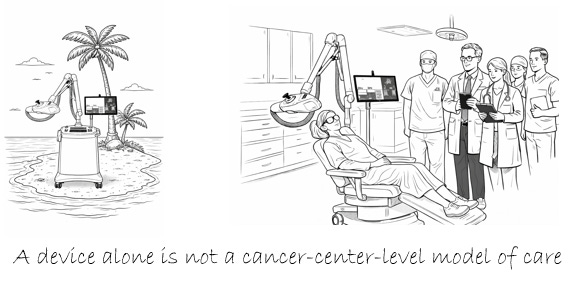
Having the technology is not the same as delivering the treatment…
and right now, that distinction is being blurred intentionally.
In the first article of this three-part series, we made the case that image-guided superficial radiation therapy (IGSRT) represents a meaningful advancement in the treatment of nonmelanoma skin cancer.
But that advancement only matters if it’s delivered correctly.
Which leads to a more important, and more uncomfortable question:
Who is actually delivering IGSRT in a way that produces the outcomes everyone is now quoting?
The Narrative That Sounds Right, But Isn’t
Some manufacturers, including Sensus Healthcare, have been promoting a simple message:
Buy the device, and you can deliver IGSRT.
On paper, that’s appealing.
In practice, it’s misleading.
A machine does not equal a treatment, and implying otherwise ignores how oncology outcomes are actually produced.
Let’s Be Direct: A Device Alone Is Not a Care Model
The idea that purchasing a Sensus 100-Vision system is sufficient to deliver “world-class” IGSRT outcomes deserves scrutiny, because:
A device does not define clinical protocols.
A device does not ensure that imaging is interpreted correctly.
A device does not create consistency across patients.
A device does not manage quality over time.
And most importantly:
A device does not replicate the outcomes being published.
The Data Everyone Is Quoting … Look Closer
The 99%+ control rates associated with IGSRT are real.
But here’s what is often left unsaid:
Those outcomes are not coming from dermatologists who simply purchased a device.
They are coming from:
Structured, protocol-driven environments
Standardized workflows
Consistent imaging and treatment methodologies
They are coming, overwhelmingly, from GentleCure-affiliated practices.
Why That Matters More Than People Realize
When outcomes are this strong, it’s tempting to attribute them to the technology itself.
But in reality:
Technology sets the ceiling.
Execution determines whether you ever reach it.
And execution in IGSRT is not trivial.
Without structure, variability returns.
And when variability returns, outcomes follow.
The “There’s No Difference” Argument
As IGSRT adoption grows, a more explicit claim has started to surface:
That there is no meaningful difference between:
A structured treatment model
And a dermatologist using the same device independently
The logic usually goes something like this:
Same machine. Same number of fractions. Same treatment. So, the outcomes should be the same.
On the surface, that sounds reasonable.
It’s also a profound oversimplification of how cancer care actually works.
Why That Argument Breaks Down
Reducing IGSRT to:
A device
And a fixed number of fractions
misses nearly everything that determines outcome quality.
Because the real variables aren’t just:
What machine is used
Or how many treatments are delivered
The real variables are:
How imaging is performed
How tumor depth is interpreted
How treatment is adjusted over time
How consistently protocols are followed
How quality is maintained across every case
That’s where outcomes are won or lost.
The Fallacy at the Center of the Debate
The idea that outcomes are determined solely by the machine, and not by the system delivering the care, is not how oncology works. And it never has been.
If identical tools automatically produced identical outcomes:
Every surgeon using the same instrument would have the same complication rates
Every radiation center using the same equipment would produce identical results
Every dermatology practice would have the same recurrence rates
We know that’s not how medicine works.
Tools enable outcomes. They do not guarantee them.
Reducing IGSRT to a machine and a fraction schedule is like reducing a cancer center to its equipment list.
Technically accurate.
Clinically meaningless.
GentleCure: The Part That Doesn’t Come in the Box
GentleCure was built around a simple reality:
IGSRT only works as well as the system delivering it.
It is not just access to imaging.
It’s:
Defined clinical protocols
Training and ongoing support
Workflow integration within dermatology practices
Quality oversight
A repeatable, cancer-center-level approach to care
This is why outcomes are consistent.
Not because of the machine.
Because of the model.
Patients Already Understand This, Even If the Market Doesn’t
Patients are not searching for devices.
They are not asking:
“Who has a Sensus 100-Vision?”
They are asking:
“Where can I get the best outcome?”
“What treatment can I trust?”
And increasingly:
They are seeking out GentleCure by name.
Because patients intuitively understand something the market is still catching up with:
Consistency is not created by equipment. It’s created by systems.
Where This Is Heading
IGSRT is not just raising expectations for what’s possible in non-surgical skin cancer treatment; it’s raising expectations for how care is delivered.
As those expectations rise, the difference between:
Having the tool
And delivering the outcome
will only become more visible.
The Takeaway
A device can enable IGSRT.
Only a model can deliver it well.
And in a field where outcomes matter this much, that distinction is everything.
In our next article, I’ll explore how, despite its shortcomings, SRT might still play a limited role.
I’m Adam Lefton, and I’m the Chief Brand Officer for GentleCure by SkinCure Oncology. Together, with our 400-plus practice partners, we’re changing the face of skin cancer treatment in America.
Stay Ahead of the Shift
The conversation is evolving quickly—and the practices that understand these distinctions early will be the ones that lead.
Subscribe to Skin Cancer Treatment Journal to follow the series, where we’ll next explore:
Why SRT may still have a role in certain settings
And how access—not just outcomes—shapes real-world treatment decisions