
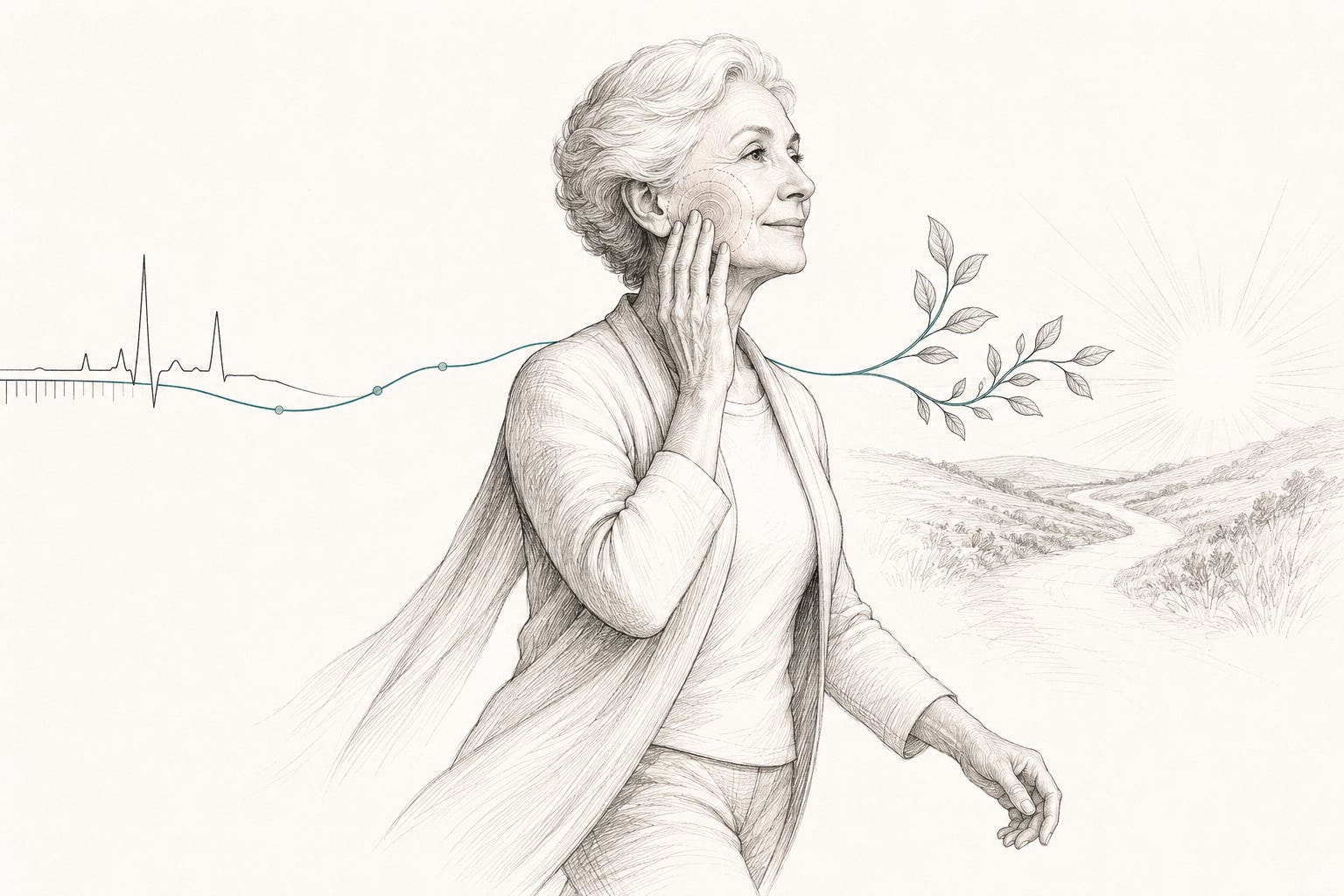
For most of human history, medicine had one primary job: keep you alive.
That was a reasonable goal when infections killed young people and the average life expectancy hovered somewhere in the mid-forties. Survival was the whole point. Adding years was the measure of success.
We largely solved that problem. Over the past century, medicine extended human lifespan in ways that would have seemed miraculous to prior generations. Americans born today can expect to live well into their late seventies, and my own dad turns 93 in August. That is an extraordinary achievement.
But something unexpected happened when we got there.
We started noticing that adding years to a life is not the same thing as adding life to those years. We had gotten very good at keeping people alive. We had not gotten equally good at keeping people well.
The Rise of Healthspan
The medical community began grappling with this distinction in earnest in the 1980s, when Stanford physician James Fries introduced the concept of “compression of morbidity”. The idea is that the goal of medicine should not just be to extend life, but to compress the period of illness and decline into the shortest possible window before death. He was, in essence, asking medicine to aim for something more ambitious than longevity. He was asking it to aim for quality.
The term that eventually emerged to capture this idea is “healthspan”, the period of life spent in genuine, good health: physically capable, cognitively sharp, free from serious disease, and able to do the things that make life worth living.
Lifespan and healthspan are not the same thing, and the gap between them is where modern medicine still has considerable work to do. You can live to ninety with a decade of chronic illness, diminished mobility, and procedural interventions. That is a long lifespan. It is not necessarily a long healthspan.
The distinction matters because it reframes the entire goal of medicine. If lifespan is the metric, you optimize for survival at all costs. If healthspan is the metric, you optimize for preserving function, minimizing invasiveness, reducing recovery burden, and maintaining quality of life at every stage of care. Those are different questions. They often lead to different answers.
Why This Shift Is Accelerating Now
Interest in healthspan has moved well beyond academic gerontology. It is now one of the defining orientations of a new generation of physicians, researchers, and patients alike. Figures like Peter Attia, David Sinclair, and others have brought the concept into mainstream medical conversation, and patients are arriving at appointments having already internalized the framework. They are not just asking “will this cure me?” They are asking “what will this do to my body? How long will I need to recover? What will my life look like after?”
These are healthspan questions. And they are reshaping patient expectations across nearly every medical specialty, including dermatology.
Skin Cancer Is Not Exempt from This Conversation
More than 4.7 million Americans are diagnosed with nonmelanoma skin cancer each year. The vast majority will survive. Survival, for most NMSC patients, is not the hard part. What matters increasingly to these patients is how they are treated — and what their face, their nose, their earlobe, their daily routine looks like on the other side of treatment.
For decades, the default answer to that question was surgery. Mohs micrographic surgery is highly effective, and for many patients it remains the appropriate choice. But surgery is not free of consequence. It involves cutting, bleeding and discomfort. It requires anesthesia, excision, reconstruction, wound care, and recovery time. It brings added risk of infection and requires aftercare and in some instances reconstructive surgery. For patients who are elderly, immunocompromised, on anticoagulants, or simply anxious about an invasive procedure on their face, those consequences are not trivial. They are, in many cases, the dominant concern.
This is where a healthspan lens changes the clinical conversation.
A Treatment Philosophy Built Around Healthspan
Image-Guided Superficial Radiation Therapy (IGSRT), delivered through GentleCure, offers an approach to nonmelanoma skin cancer that is, by design, aligned with healthspan thinking. It is non-surgical and non-invasive. There are no incisions, no anesthesia, no sutures, and in most instances involves no wound recovery. The body, guided by low-energy radiation precisely targeted through real-time high-resolution ultrasound imaging, does the work, gradually replacing damaged cancer cells with healthy tissue.
For appropriate patients, the clinical outcomes are not a compromise. Peer-reviewed studies document local control rates above 99%. Patient satisfaction, in the largest study to date, sits at 99.8%. And cosmetic outcomes, particularly in areas like the nose, eyelids, ears, and lips, consistently outperform what surgery can achieve, because healthy tissue replaces cancer cells rather than scar tissue filling the void left by excision.
But beyond the data, what GentleCure represents is a treatment philosophy. It asks not just “can we cure this cancer?” but “how do we cure it in a way that respects the patient’s whole life?” That is a healthspan question, and it is the right question to be asking.
The Standard of Care Is Evolving
Medicine has always moved toward less invasiveness when the evidence supports it. Radical mastectomy gave way to lumpectomy. Open surgery gave way to laparoscopy. The trajectory is consistent: when precision improves and outcomes are preserved, patients should not have to endure more than they need to.
Dermatology is at that inflection point now. The field has a non-surgical option with strong cure rates, overwhelming patient satisfaction, and a treatment experience that preserves what patients value most: their appearance, their comfort, and their time.
The rise of healthspan as a guiding principle in medicine is not a trend. It is a correction. After a century of optimizing for survival, we are finally asking the harder question: surviving to what end?
For patients facing a skin cancer diagnosis, the answer to that question has never been more important and has never been more achievable.
I’m Adam Lefton, and I’m the Chief Brand Officer for GentleCure by SkinCure Oncology. Together with our 400-plus practice partners, we’re changing the face of skin cancer treatment in America.