
There’s an old business truth I’ve quoted in my books and presentations to leading organizations for years: Customers don’t want a drill. They need a quarter-inch hole.
The product is not the point. The outcome is.
Nobody wants the drill for its own sake. They want what it helps them achieve. They want the shelf on the wall. The picture frame hung. The repair completed.
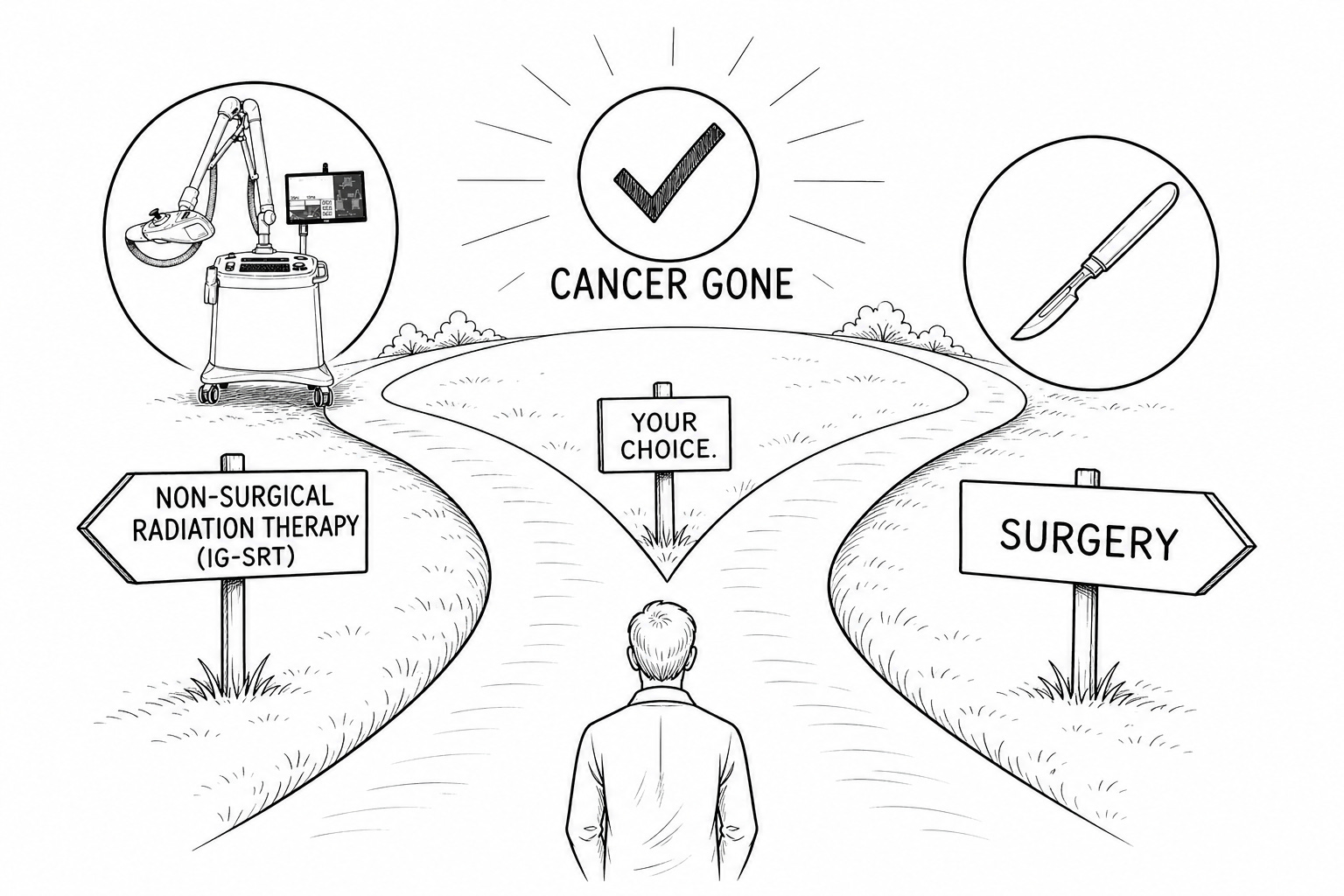
That same principle may be nowhere more important than in healthcare. A patient diagnosed with skin cancer does not want a procedure. They want the cancer gone.
For decades, Mohs surgery has been the standard route many patients are offered to achieve that outcome. In many cases, it remains an important and effective option.
But let’s be candid: Patients are not emotionally attached to surgery. They are attached to resolution.
The procedure is the method. The cure is the objective. That distinction changes everything. Because once we focus on what the patient actually needs and wants, the real question becomes:
Are they being informed about every clinically appropriate path to that result? This is the point where trust either deepens or disappears.
Think about what happened in transportation. People never wanted a cab. They wanted to get somewhere. When Uber introduced a different, more convenient way to achieve the same objective, the market shifted.
The need didn’t change. The method did.
The same thing happened with film and digital photography. With DVDs and streaming. With retail and e-commerce. Dr. Clayton Christensen’s research at Harvard demonstrated that customers do not buy methods — they hire them to get a job done.
In other words, innovation rarely changes what people fundamentally need. It changes how they can best achieve it.
Healthcare is no exception. Patients facing non-melanoma skin cancer want effective treatment. If image-guided superficial radiation therapy (IG-SRT), through GentleCure, offers a clinically appropriate, non-surgical alternative for certain patients, then it deserves to be part of the conversation.
Not because one method must replace another, but because patients deserve informed choice. And here is where the stakes become much higher than medicine alone. When a patient later learns there was another viable option they were never told about, trust begins to fracture.
That fracture often starts with one simple question: Why wasn’t I told?
From there, the erosion accelerates. What else am I not being told? Was this recommendation truly about me – or about the doctor wanting to make more money? Did I receive the best guidance — or merely the most profitable one?
In any business, withholding viable alternatives damages loyalty. In healthcare, it can destroy trust altogether.
That is why this is not merely a clinical conversation.
· It is a patient experience conversation.
· It is an ethics conversation.
· It is a leadership conversation.
History is filled with incumbent systems trying to slow innovation.
· Taxi companies fought ridesharing.
· Blockbuster resisted streaming.
· Kodak underestimated digital.
Delay almost never stops progress. It only delays the customer’s benefit.
And in medicine, the consequences are more profound because the person paying the price is not the institution. It is the patient. This is why the future of care cannot be built solely around preserving traditional methods. It must be built around protecting the patient’s right to understand all appropriate options.
Because patients do not want a procedure. They want a cure.
· They want confidence.
· They want transparency.
· They want the dignity of informed choice.
And when that choice is withheld, trust doesn’t just weaken. It evaporates.

