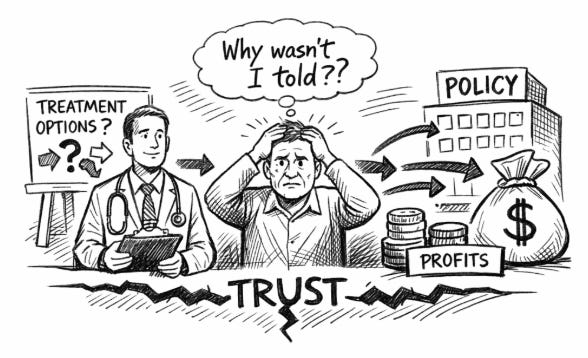
Policy and Patient Trust
There’s an uncomfortable truth about the patient experience that doesn’t get discussed nearly enough: trust in healthcare is incredibly fragile.
Not because physicians don’t care. Not because patients expect perfection.
Trust erodes when patients discover something they weren’t told.
If a patient later learns there was another treatment option—especially one that might have been less invasive, more convenient, or better aligned with their preferences—the damage to trust is immediate. And in most cases, it’s irreversible.
I’ve seen this repeatedly, both in my work with medical professionals and my personal experience.
A patient might accept a recommendation without hesitation. They believe their physician has explained the landscape of choices. But later—perhaps through another doctor, an online search, or a conversation with another patient—they discover there was another path available.
At that moment, the question changes. It’s no longer, “What treatment should I choose?” Instead, it becomes, “Why didn’t anyone tell me?” or “Why would I trust a doctor who kept a clinically effective option a secret from me in order to secure a larger reimbursement for their medical services?”
And once either of those questions enter the patient’s mind, confidence in the system starts to collapse.
Most of the time, this isn’t about deception. It’s about systems.
Healthcare today is influenced by layers of reimbursement policies, coverage decisions, billing codes, and advocacy pressures that shape which treatments are widely available and which quietly fade from view.
· Physicians operate within those realities.
· But patients don’t experience the policy debates.
· They experience the absence of choice.
And when that absence becomes visible, the emotional impact is enormous.
Here’s what makes this even more fascinating…and troubling. This pattern isn’t unique to medicine. It happens in virtually every industry when disruptive innovation appears.
· Taxi companies fought ridesharing.
· Hotels resisted home-sharing platforms.
· Retailers tried to slow e-commerce.
· The established system almost always tries to protect the status quo.
But history shows something important:
Attempts to suppress innovation rarely succeed.
They may slow progress temporarily, but they almost never stop it. What they do instead is delay access for the customer, and the customer pays the price for that delay.
In most industries, the cost of delay is inconvenience. In medicine, the cost can be far more significant.
· Patients are impacted physically.
· They’re impacted emotionally.
· And very often, they’re impacted financially.
Which brings us back to the heart of the patient experience.
The Ultimate Customer Experience®, whether in retail, hospitality, or healthcare, requires something simple but powerful: transparency and choice.
Patients don’t expect doctors to know everything. They do expect to be informed. They want to understand their options. They want to participate in decisions about their care. And when they feel that information has been limited, whether intentionally or structurally, the trust that healthcare depends upon begins to erode.
This is why the conversation around treatment access, reimbursement policy, and innovation matters so much. It isn’t just a policy debate. It’s a patient experience issue.
And ultimately, patient experience is about trust. Because when patients believe they have been given the full picture—even if the decision is difficult—they remain confident in their physician and in the system.
But when they discover the picture wasn’t complete, the relationship changes instantly.
In business, losing a customer is unfortunate. In medicine, losing trust can be far more serious.
Patients deserve a system where innovation is evaluated honestly, options are discussed openly, and decisions are guided by evidence and patient preference—not by the quiet gravity of reimbursement structures.
Because the most important principle of patient experience is also the simplest:
· People can accept difficult news.
· They rarely forgive hidden choices.