
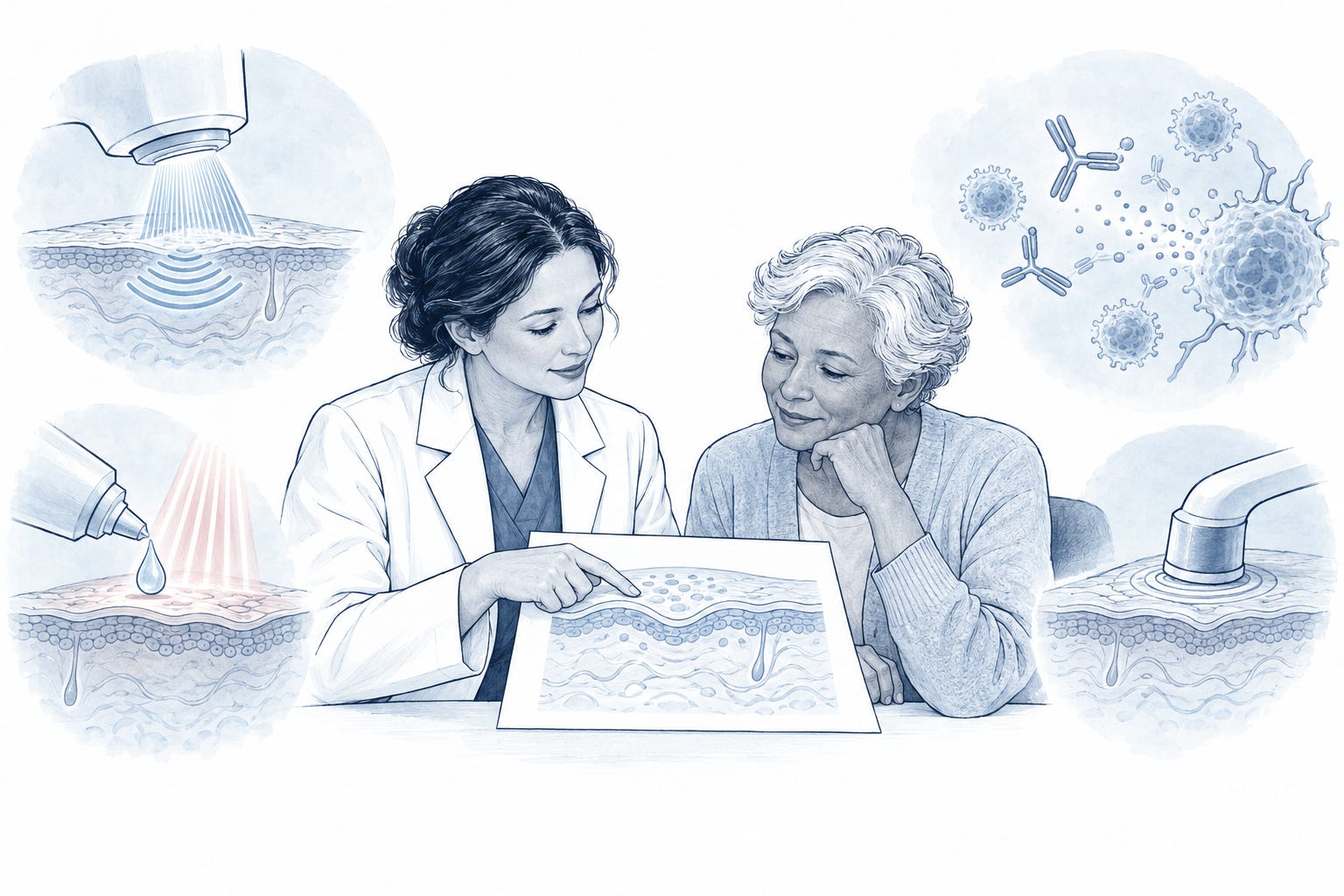
On September 14, 2026, the FDA approved aminolevulinic acid hydrochloride 10% topical gel in combination with red-light photodynamic therapy for superficial basal cell carcinoma in adults, making it the first and only photodynamic therapy approved in the United States to treat a skin cancer. A commercial rollout is planned for late Q4 2026 through Q1 2027.
It is a narrow approval. It applies to one subtype of one skin cancer, and superficial BCC accounts for an estimated 10% to 25% of BCC diagnoses. But BCC is the dominant share of a very large denominator. By our own updated modeling, roughly 4.7 million Americans will be diagnosed with nonmelanoma skin cancer in 2026, accounting for an estimated 6.7 to 7.7 million lesions.1 Even a narrow indication, in a population that size, reaches a great many people.
More to the point, the approval is a useful marker of where the field is heading and it’s a good moment to ask the question we hear from patients when a biopsy result comes back: what are my options that aren’t surgery?
Here is the honest answer, organized by what each option is actually for.
First, what “non-surgical” really means
The phrase gets used loosely. In practice, patients asking about non-surgical treatment are asking about three different things at once: no scalpel, no stitches, and no reconstruction. Some options meet all three. Some meet none of them but still get marketed as minimally invasive.
Curettage and electrodesiccation, for instance, is often grouped with non-surgical options because it happens in an exam room in minutes. It involves scraping the tumor and burning the base, and it is classed as a first-line therapy for low-risk BCC alongside standard surgical excision. Whether you call that surgery is a semantic question. The patient will experience it as a wound.
The genuinely non-surgical options fall into four buckets.
1. Radiation therapy: curative intent without cutting
This is the largest and most established category, and the one with the most internal variation.
Image-guided superficial radiation therapy (IGSRT)
IGSRT pairs conventional kilovoltage superficial radiation with high-resolution dermal ultrasound, so the treating team can visualize lesion depth before and during the course and adjust energy accordingly. A multi-institutional retrospective analysis of 1,709 patients with 3,050 stage 0, I, and II lesions reported absolute local control of 99.2%, with control rates of 99.0% for BCC, 99.2% for SCC, and 99.8% for SCC in situ, at an average follow-up of 25.1 months. A separate cohort study found two-year freedom from recurrence of 99.23% and reported that image-guided treatment performed significantly better than superficial radiation delivered without image guidance. A larger analysis of 19,988 lesions found no difference in freedom from recurrence between more and less socioeconomically deprived neighborhoods, or between patients with few and many comorbidities.
The trade-off is time. Actual treatment takes less than 2 minutes per session, and patients are typically in and out of the doctor’s office in 15 minutes, but 20 sessions over six to seven weeks is typical.
GentleCure is Image-guided SRT, but not all image-guided SRT is GentleCure. GentleCure ensures that patients receive cancer-center-level care in a dermatology office setting, and many of the major studies showing a better-than 99% cure rate use data from practices offering GentleCure. You can’t necessarily apply that cure rate to other types of radiation therapy, although those offering other types of radiation like to quote a 99% cure rate without actual studies to support their claims.
Traditional superficial radiation therapy (SRT)
The same modality without the ultrasound. It has a much longer clinical track record, with outcomes literature going back to 1990, but cure rates may be significantly lower than they are when imaging is used on every treatment session.
Electronic brachytherapy and HDR surface brachytherapy
These deliver radiation from a source placed directly against the skin using a surface applicator, over fewer and larger fractions. While there are fewer studies supporting superior cure rates for surface brachytherapy, one long-term study reported a cure rate of greater than 98% at a median follow-up of 7.6 years.
External beam radiation
Electron beam or orthovoltage radiation is the option for larger, deeper, or perineurally involved tumors that superficial modalities cannot reach.
2. Topical and light-based therapy: for superficial disease only
Topical treatments such as imiquimod and 5-fluorouracil, along with photodynamic therapy and cryotherapy, are increasingly used for patients who are elderly, have significant comorbidities, or have tumors in cosmetically sensitive areas.
5-fluorouracil is a topical chemotherapy the patient applies at home for several weeks. Imiquimod is a topical immune response modifier on a similar schedule. Both produce a period of visible inflammation that patients frequently find more painful than they expected, and both are limited to superficial lesions.
Photodynamic therapy applies a photosensitizing agent to the lesion, waits for it to concentrate in the tumor, and then activates it with light. The new approval gives it a formal U.S. indication in skin cancer for the first time. In the supporting phase 3 trial, one to two PDT cycles produced 65.5% complete clinical and histologic clearance at 12 weeks. The cure rate is clearly inferior to radiation-based treatment but shows promise.
Laser ablation also appears in this category. It may be an option for very superficial BCCs, but whether it matches standard treatments in effectiveness is not established, and it is not widely used.
3. Systemic therapy: for advanced disease
These are not alternatives to surgery for early-stage lesions, but may be useful when treating locally advanced or metastatic disease.
Hedgehog pathway inhibitors — vismodegib and sonidegib — are used in advanced BCC. NCCN recommends multidisciplinary tumor board consultation with consideration of vismodegib or a clinical trial for complicated lesions where radiation and surgery have been exhausted or are impractical.
PD-1 inhibitors have moved earlier in the treatment sequence. On October 8, 2025, the FDA approved cemiplimab for high-risk cutaneous squamous cell carcinoma based on findings that patients treated after surgery and radiation went longer without recurrence than those receiving surgery and radiation alone, making it the first approval aimed at preventing recurrence in high-risk patients after surgery and radiation, rather than treating disease where surgery is no longer possible.
4. Not available in the USA
Rhenium-SCT is a beta-emitting radionuclide applied as a resin on a foil over the lesion and delivered in a single outpatient session. It is approved for shallow BCC and SCC lesions up to 3 mm deep and 8 cm² in area, without perineural invasion or high-risk pathology. It is being tested in Australia, New Zealand, South Africa, Europe, and the UK but it is not FDA-approved in the United States.
This estimate replaces the widely cited 3.3 million figure, which traces to a Medicare-based analysis now well over a decade old. The 2026 estimate is derived from four convergent models — a demographic-floor model, a conservative CAGR projection, a MEPS benchmark, and a re-run of the original source paper’s method — all of which converge on 4.7 million as a conservative figure. Full methodology is available from the Journal of Skin Cancer Treatment.
The real questions patients are asking
Patients rarely ask about non-surgical options in a vacuum. They ask because someone recommended surgery and they want to know whether that recommendation was about their tumor or about the office they happened to walk into.
Recent patient survey data bears that out:
In a survey of more than 5,000 patients, published by DART (The Dermatology Association of Radiation Therapy), 74% of patients receiving radiation therapy reported being fully informed about all treatment options, compared with only 26% of patients receiving surgery and 31% of patients receiving some other therapy.
That’s clearly not in tune with what patients desire.
The survey “Public Perspectives on Skin Cancer Treatment and Patient Choice,” conducted by SkinCure Oncology, asked more than 1,000 patients, “If two treatments for skin cancer had similar cure rates, which would patients prefer?” 23% said that it would depend on the specific situation, while 71% said they would prefer a non-surgical solution and only 3% chose surgery.
Here is what that means practically. The clinical variables that should drive the decision are depth, histologic subtype, anatomic location, margin definition, recurrence status, and patient-specific factors such as anticoagulation, wound healing, and comorbidity burden. If a patient’s conversation with a provider never touches those variables and arrives at a recommendation anyway, the recommendation was probably made before the conversation started.
What to ask
What is the histologic subtype, and how deep does the biopsy suggest this goes? This single answer eliminates or enables most of the options above.
Which of these treatments does this practice actually provide? Ask it directly. The answer is not a criticism of the practice; it is the shape of the menu.
What cosmetic and functional outcome do you expect from each, at this location? Nose, eyelid, ear, and lip are where the answers diverge most.
What is the follow-up plan if the first treatment does not achieve clearance? Every option on this list has a salvage pathway. The patient should know theirs before starting, not after.
What is the time commitment, and can I meet it? Six weeks of near-daily treatment is not the same ask as one office visit, and for a patient without reliable transportation it is sometimes the harder one.
Takeaway
Ten years ago, the non-surgical conversation in the United States was essentially around non-image guided radiation, topicals, and cryotherapy. Today it includes image-guided radiation with published multi-institutional outcomes, surface brachytherapy with long-term follow-up, an FDA-approved photodynamic therapy, and immunotherapy that has moved from salvage to adjuvant. Ten years from now it will likely include at least one additional treatment currently on the not-available-here list.
Non-surgical options for the treatment of nonmelanoma skin cancer are no longer relegated to the category “if surgery is not an option.” Patients want and are beginning to demand to know their options and more than ever feel empowered to pursue their treatment of choice.
Disclosure: The author is Chief Brand Officer at SkinCure Oncology, which provides image-guided superficial radiation therapy (IGSRT) through its GentleCure program. IGSRT is one of the modalities discussed above.