
Most Americans believe something simple.
When a physician becomes a doctor, they swear an oath to “first, do no harm.”
It’s comforting.
It’s also not quite true.
And the gap between what patients believe governs medicine and what actually governs medicine is where the real problem begins.
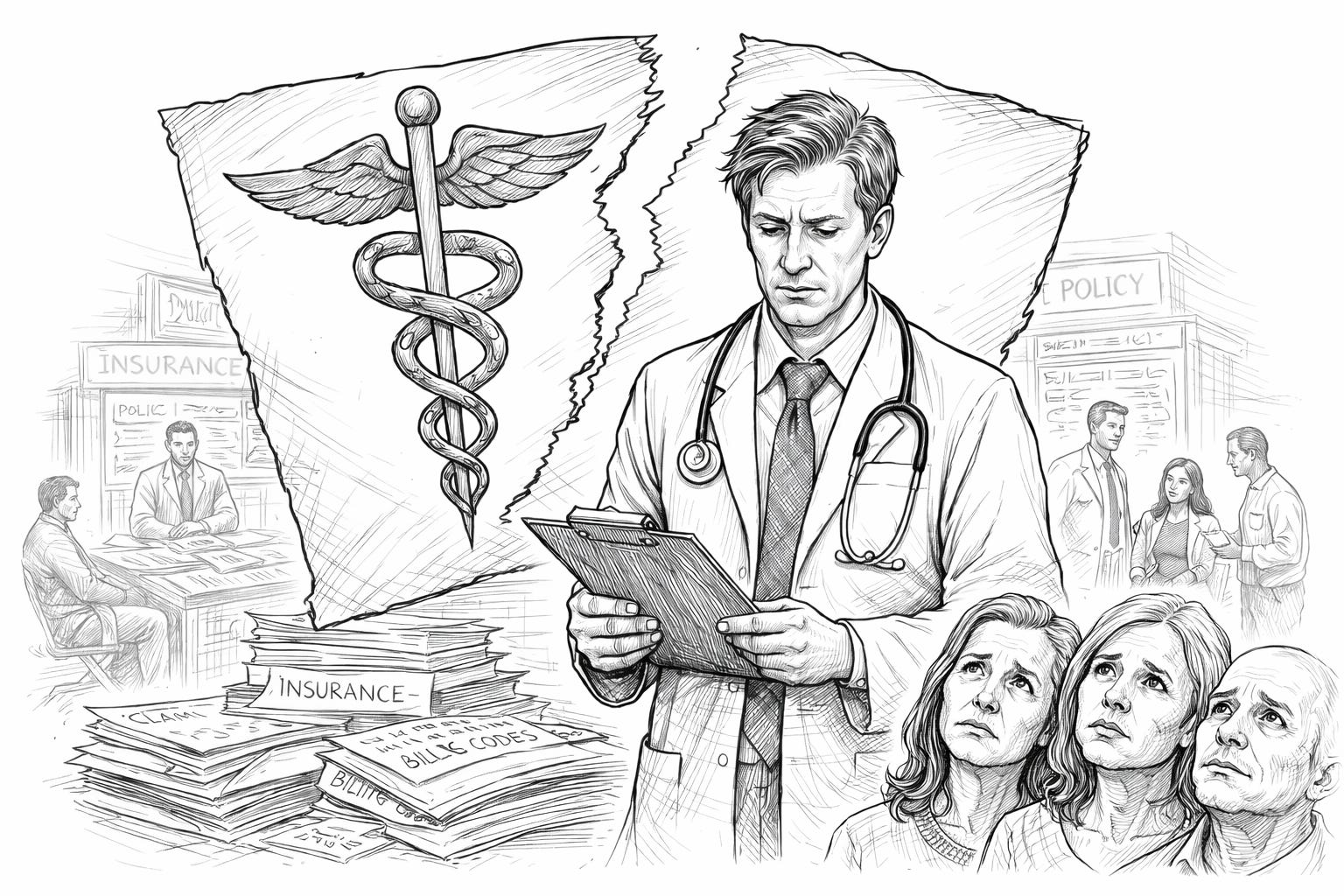
Because the Hippocratic Oath didn’t disappear, it was outpaced.
The Oath We Think We Know
The Hippocratic Oath is one of the most famous ethical pledges in history. It dates to ancient Greece and has long symbolized medicine’s moral foundation.
But here’s the first surprise:
The phrase “first, do no harm” does not actually appear in the original oath.
It’s a paraphrase, a modern summary of a broader ethical philosophy.
The classical oath emphasizes things like:
Practicing medicine ethically
Avoiding exploitation
Maintaining confidentiality
Acting for the benefit of the sick
It is about responsibility, integrity, and restraint.
It is not a legal contract, and it’s not enforceable in court.
It is a moral declaration, and that distinction matters.
Medicine Today Is More Complicated Than an Oath
Modern medicine cannot literally “do no harm.”
Surgery causes harm to remove a tumor.
Radiation damages tissue to destroy cancer.
Chemotherapy weakens the body to save a life.
So, in practice, the principle has evolved into something more realistic:
Minimize harm.
Avoid unnecessary harm.
Act in the patient’s best interest.
That remains the ethical aspiration of medicine, but aspiration and authority are not the same thing, because today the oath does not determine which treatments are available. Policy does.
Do Doctors Still Take the Oath?
Often, yes, but not always, and not uniformly.
Many U.S. medical schools hold oath ceremonies. Some use a modernized Hippocratic Oath. Others use alternatives such as:
The Declaration of Geneva, which emphasizes human rights and patient dignity.
The AMA Code of Medical Ethics, which guides professional behavior.
Institution-specific pledges, which reflect modern values like equity and autonomy.
The language changes, but the spirit remains.
But here’s the reality: no physician loses their license for “breaking the oath.”
They lose it for violating laws, regulations, or standards of care.
The oath is symbolic.
The system is structural.
What Happens When Doctors Do Harm?
We should be clear: most harm in medicine is not malicious.
Complications happen. Bodies are complex. Outcomes aren’t guaranteed.
When a physician is negligent, there are consequences:
malpractice lawsuits
State Medical Board Discipline
loss of hospital privileges
When misconduct is intentional, consequences can include criminal charges.
Those safeguards exist for a reason.
But the harm patients increasingly experience today doesn’t usually come from rogue doctors.
It comes from something quieter, something bureaucratic and embedded in the system today.
The Modern Power Structure of Medicine
Medicine today runs on reimbursement.
Billing codes.
Coverage policies.
Local Coverage Determinations (LCDs).
Private payor rules.
Medicare frameworks.
These mechanisms shape what doctors can realistically offer, and what patients can realistically access.
In theory, reimbursement policy exists to promote quality and control waste.
In practice, it also determines which innovations survive.
When coverage decisions narrow access to certain modalities, especially those that compete with established procedural pathways, the effects ripple outward.
This is why ongoing debates involving payor codes, LCDs, and advocacy by organizations such as ACMS and ASTRO are not abstract professional disputes.
They are access disputes.
When reimbursement is limited for a treatment option, patients don’t see the policy debate, and they see fewer options and longer delays.
They see providers who stop offering certain therapies because the economics no longer work.
They see care shaped not less by evidence, and more by infrastructure.
Even when so-called advocacy groups argue they are protecting “quality,” the practical result can still be reduced access - and reduced access can be a form of harm.
Harm Doesn’t Always Look Like Malpractice
It looks like:
An elderly patient steered toward a more invasive procedure because the less invasive option isn’t covered.
A cancer patient told, “Insurance won’t approve that.”
A rural patient traveling hours because only a handful of centers can still afford to offer a modality.
A physician who believes in an option, but knows reimbursement makes it nearly impossible.
No oath was broken in those moments, no doctor acted maliciously, but patients still paid the price.
The Incentive Problem
The Hippocratic Oath was written for a world in which the physician stood directly between the patient and illness.
Modern healthcare inserts layers in between:
Payors
Policymakers
Specialty societies
Reimbursement committees
Utilization management systems
When those layers align with patient outcomes, the system works.
When they align with protecting existing economic models, tension emerges.
When economic preservation outweighs innovation or patient preference, access narrows.
The oath doesn’t disappear; it just loses its leverage.
What Should Change
If we truly believe medicine should “do no harm,” then the ethical lens must extend beyond the exam room.
It must apply to:
Coverage decisions
LCD determinations
CPT code valuation
Reimbursement frameworks
Specialty advocacy positions
Policy should prioritize:
Evidence-based outcomes
Patient-centered access
Transparency in decision-making
Balanced representation in coverage deliberations
When reimbursement policy becomes the de facto gatekeeper of innovation, ethics must inform those policies - not trail behind them.
Patients deserve a system where access is shaped by data and outcomes, not inertia or economic self-preservation.
The Oath Isn’t Dead
Physicians still care, they still advocate, and they still fight denials and push back when they can.
The Hippocratic tradition lives in exam rooms every day, but the oath is no longer the primary force shaping care. The system is.
If we want ethical medicine, we cannot stop at ethical doctors; we need ethical reimbursement, ethical coverage, and ethical policy.
When incentives drift away from patients, the harm may not be intentional, but it is real, and patients feel it every time.
I’m Adam Lefton, and I’m the Chief Brand Officer for GentleCure by SkinCure Oncology. I’m not a doctor, but over the years I’ve had conversations with thousands of doctors. I grew up in the 1960’s and 1970’s, and the thoughts expressed above reflect my personal observations of changes in the medical profession since then, as well as recent conversations with members of the medical community, those involved in healthcare reimbursement, those involved in healthcare policy, and most importantly, patients. I write today to encourage all those in positions to improve the quality of patient care to embrace the motto that we at GentleCure by SkinCure Oncology have adopted and embraced, “It’s first and always about the patient.”