
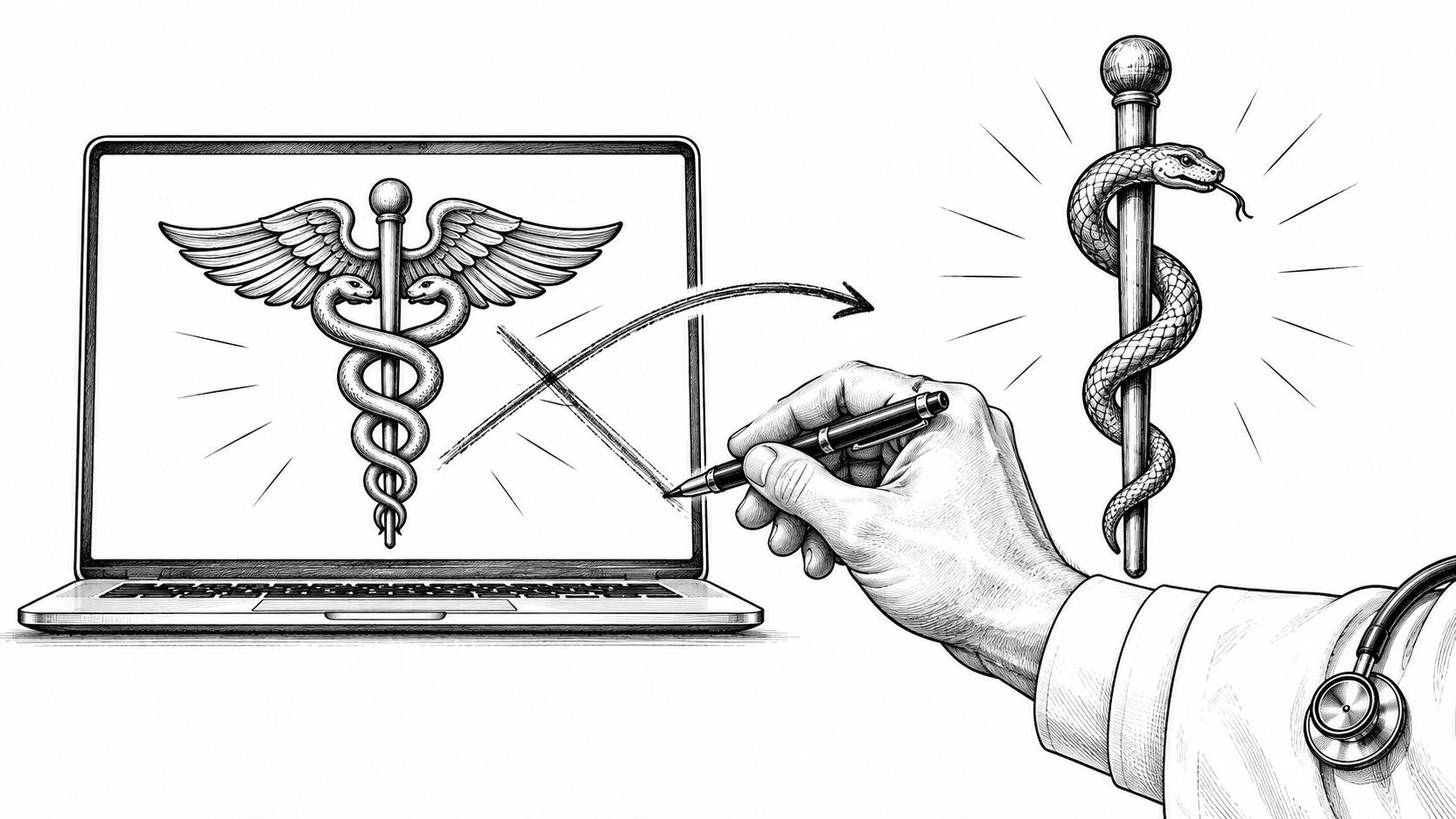
In an era where artificial intelligence is rapidly reshaping how we create, communicate, and even think, it’s easy to assume that the tools we rely on are getting the details right, especially when those details seem simple. But recently, I was reminded that even the most advanced technologies can miss something fundamental. And in medicine, those “small” details matter.
While preparing content for a skin cancer journal, I turned to ChatGPT to generate a visual, something clean, professional, and symbolically representative of medicine. Like many, I assumed the output would be accurate. What I received looked right at first glance: a staff, two serpents, and wings. Familiar. Polished. Convincing.
It was also wrong.
What ChatGPT had generated was the Caduceus, a symbol often mistakenly associated with medicine. The correct symbol, however, is the Rod of Asclepius—a single serpent wrapped around a staff, rooted in centuries of medical tradition and the mythology of healing.
I might have published it without a second thought.
But then something unexpected happened.
Dr. Bob Haber came across one of my pieces online and reached out, not to criticize, but to educate. He pointed out the distinction between the two symbols and explained their origins. The Rod of Asclepius represents healing and medicine; the Caduceus, with its twin snakes and wings, is historically tied to commerce and negotiation.
That moment stuck with me.
Not because of the mistake itself, but because of what it revealed.
The Illusion of Authority
AI tools like ChatGPT are incredibly powerful. They produce content that is articulate, visually appealing, and often highly convincing. But they are not infallible, and more importantly, they do not “understand” in the way experts do.
They predict. They assemble. They generalize.
And sometimes, they perpetuate widely accepted inaccuracies, like the misuse of the Caduceus in healthcare branding, a mistake that has been circulating for over a century.
Why This Matters in Medicine
In dermatology and oncology, precision is everything. Whether we’re discussing treatment modalities, patient outcomes, or emerging technologies like image-guided SRT, details are not cosmetic, they are clinical.
If we allow small inaccuracies to slip into our communications, we risk eroding trust. And in healthcare, trust is the foundation of everything.
The irony is that AI can amplify both accuracy and error at scale.
The Role of Human Expertise
What corrected my course wasn’t another algorithm. It was a physician. A subject matter expert. Someone with the training, historical context, and judgment to recognize what didn’t belong.
That’s the real takeaway.
AI should not replace expertise; it should augment it. It should accelerate workflows, not bypass validation. And it should always be paired with human oversight, especially in fields where credibility and accuracy are non-negotiable.
A New Responsibility for Leaders
As leaders in dermatology and healthcare more broadly, we are increasingly becoming curators of AI-assisted content. That comes with responsibility.
We must:
Question outputs, even when they look correct
Validate information against trusted sources
Stay grounded in the fundamentals of our field
Because if we don’t, we risk letting convenience override correctness.
Final Thought
I still use ChatGPT. It’s an extraordinary tool. But I use it differently now, with a more critical eye and a deeper appreciation for the role of human expertise.
And thanks to Dr. Haber, I’ll never look at a medical symbol the same way again.