
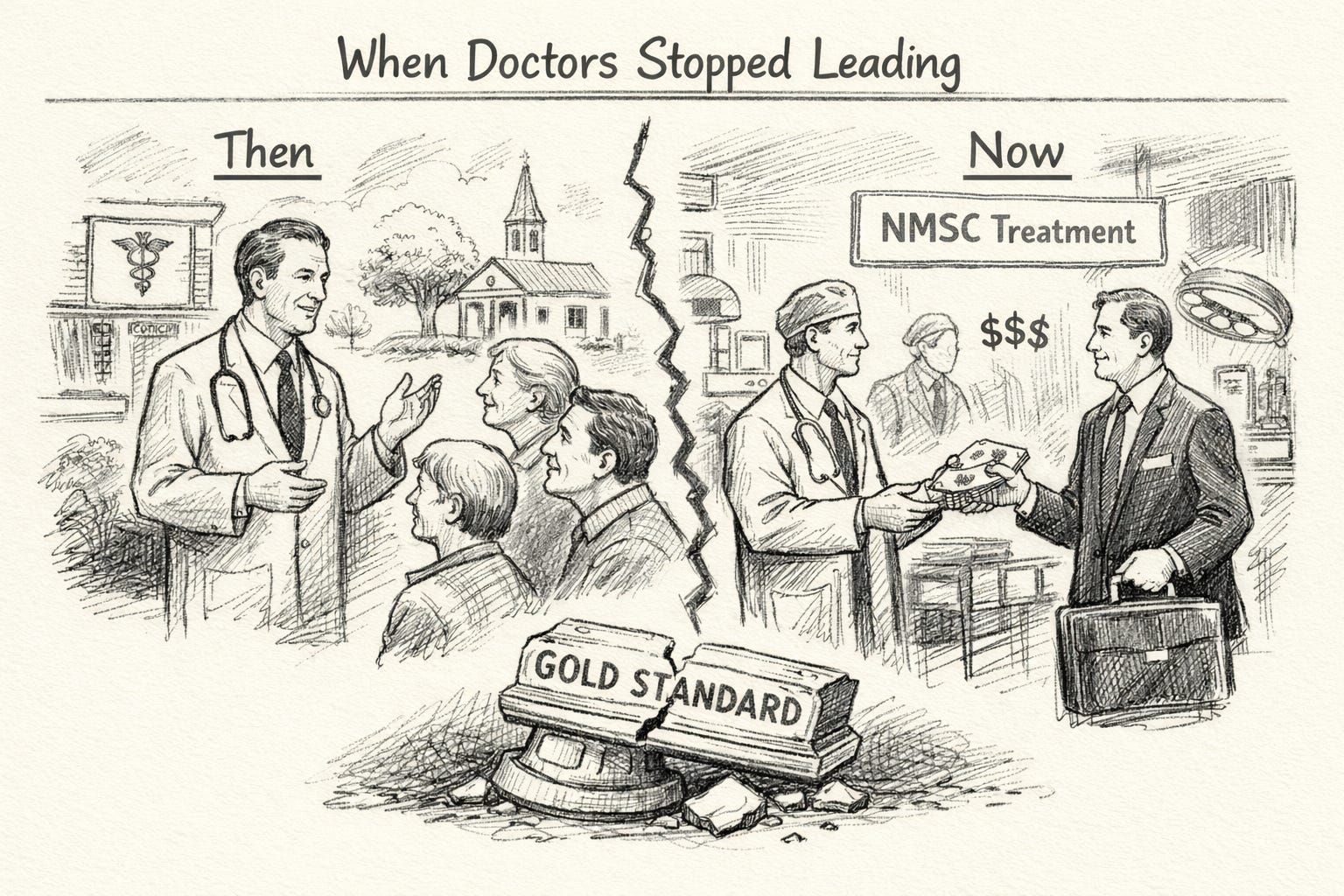
When I was growing up in the 1960s, doctors occupied a special place in the community. It’s hard to explain to anyone who didn’t live through it. Doctors weren’t just healthcare providers—they were trusted voices. We listened to them, deferred to them, and believed they were acting in our best interest. Doctors didn’t need to advertise their credibility. They simply had it. We were raised to trust and respect doctors, so we did. Somewhere along the way, that changed. It wasn’t sudden, and it wasn’t inevitable, but it happened.
I’ve been thinking about this a lot lately. More than 3 million Americans will be diagnosed with skin cancer in 2026. About one in three will require significant intervention, something more than a topical cream, a quick freeze, or a “let’s watch it for now.” These are real patients facing real decisions, and the stakes are high. But behind the clinical language and professional courtesy, there’s also something else happening: a quiet war over who gets to treat these patients, who controls the narrative around “standard of care,” and who profits most from the path chosen. No one wants to frame it that way, and certainly no one wants to say the word profit out loud. But pretending it isn’t part of the conversation doesn’t make it less true.
Today: The Skin Cancer Crisis, and the Quiet Battle Behind It
For decades, Mohs surgery has been referred to as the “gold standard” for treating certain skin cancers. However, continuing to rely on that label in today’s clinical environment ignores meaningful advances in non-surgical care, most notably image-guided superficial radiation therapy (IGSRT). With documented cure rates of 99.3%, IGSRT has demonstrated outcomes that are at least comparable to Mohs, while offering a non-invasive alternative that preserves anatomy, avoids surgery, and is particularly well suited for cosmetically and functionally sensitive areas. In medicine, standards should be defined by current evidence and patient-centered outcomes—not historical precedent.
Persisting in branding Mohs as the “gold standard” risks misleading patients into assuming it is inherently superior, when modern data show that multiple effective options now exist. Delivered through the GentleCure Experience, IGSRT combines advanced imaging, precise targeting, and a highly patient-friendly treatment journey, challenging the notion that surgical intervention should automatically be considered the benchmark. If anything, Mohs represents an old standard rooted in an earlier era of technology, while IGSRT reflects the evolution of skin cancer treatment toward precision, personalization, and choice. In that context, clinging to outdated terminology does a disservice to patients who deserve to understand all clinically equivalent options available to them.
America Gave Up Its Gold Standard. Medicine Should Too.
The United States abandoned the gold standard on August 15, 1971. It’s long past time for the American College of Mohs Surgery to do the same.
In many ways, medicine has become more advanced, more sophisticated, and more profitable than ever. But in the process, doctors slowly gave up something far more valuable than income: the presumption that they were different, that they were guided first by judgment, restraint, and service rather than self-interest.
Medicine Became Wealthier and Lost Something More Valuable
Today, many physicians are among the wealthiest professionals in America. That fact alone isn’t the problem. The problem is what it symbolizes to patients. Increasingly, people believe, fairly or not, that medical decisions are shaped as much by financial incentives and professional self-protection as by patient need. Once that suspicion takes hold, trust erodes quickly.
This didn’t happen because patients suddenly became unreasonable or anti-science. It happened because medicine began to look less like a calling and more like a guild. Procedures became products. Turf became something to defend. Innovation became welcome only when it didn’t threaten existing revenue streams.
IG-SRT and the Resistance That Patients Notice
The resistance by many Mohs surgeons to image-guided superficial radiation therapy is a case in point. IG-SRT is not experimental, reckless, or unproven. For appropriate nonmelanoma skin cancer patients, it offers excellent outcomes with far less invasiveness. Yet instead of being evaluated honestly and integrated responsibly, it is often attacked, dismissed, or quietly undermined. To patients, the motive looks obvious: protect the procedure, protect the income.
Whether that perception is always fair almost doesn’t matter. What matters is that it exists, and that it’s reinforced every time physicians appear to put professional preservation ahead of patient-centered progress.
Doctors Used to Lead by Example
What makes this especially disappointing is that doctors once knew how to lead. When evidence mounted that smoking was killing people, physicians changed their own behavior first. They didn’t wait for legislation or public pressure. They acted, and society followed. That moral leadership did more to build trust than any credential ever could.
The Path Back to Trust Isn’t Messaging, It’s Action
If physicians want to regain what they’ve lost, the solution isn’t better messaging or tighter control over alternatives. It’s behavior. It’s choosing patient benefit over procedural dominance. It’s supporting effective, less invasive options even when they disrupt familiar models.
Doctors once had the public’s trust. They lost it not because the world changed, but because they did. Getting it back will require the courage to change again, this time in the right direction.
I’m Adam Lefton, and I’m the Chief Brand Officer for GentleCure by SkinCure Oncology. Together, with our 400-plus practice partners, we’re changing the face of skin cancer treatment in America.