
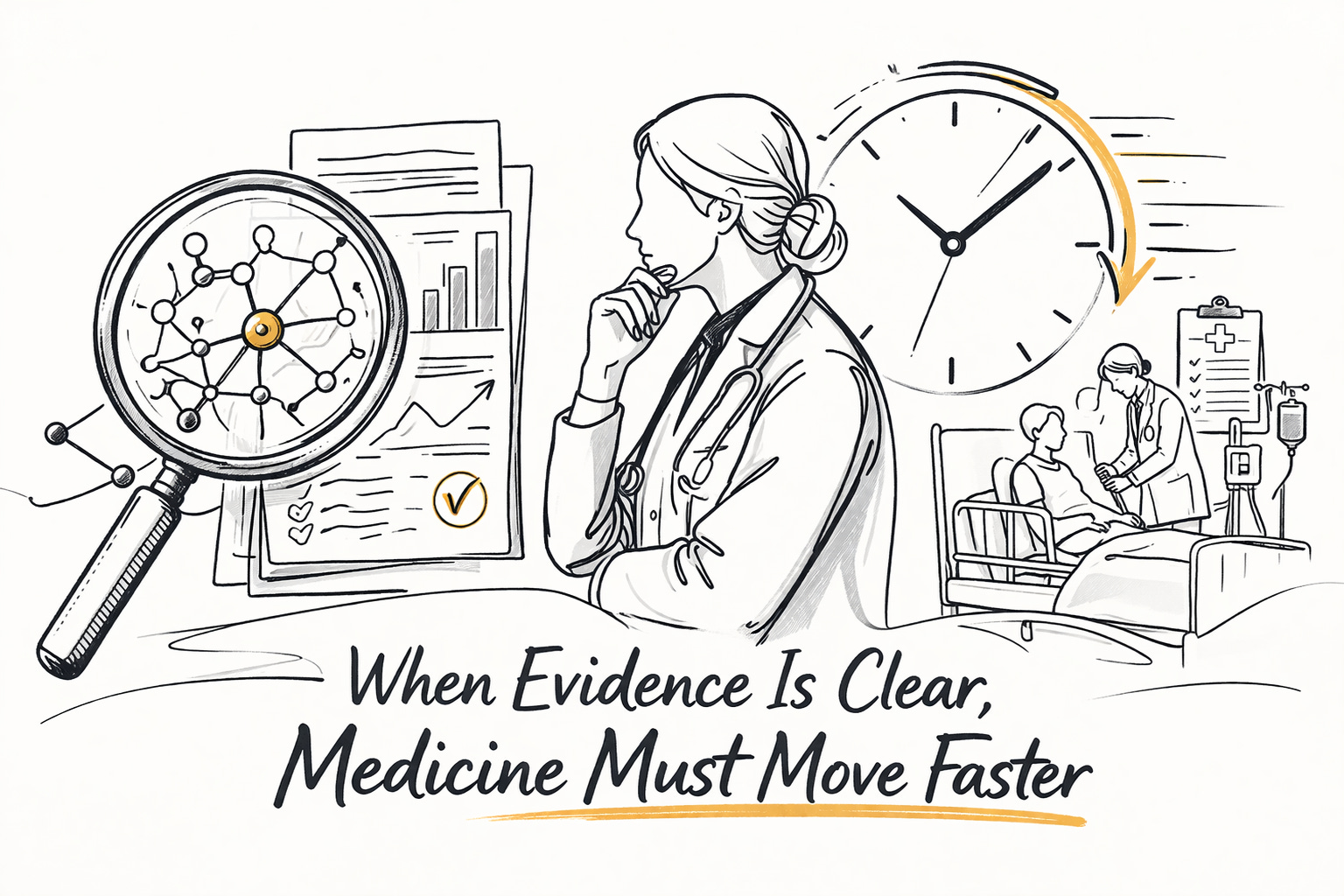
Caution Is Essential, but Inertia Has Consequences
Medicine is built on caution, and rightly so. Evidence matters. Outcomes matter. Patient safety comes first. But history shows that when caution turns into inertia, patients can suffer unnecessarily. Some of the most meaningful advances in modern healthcare were resisted long after data showed there was a better way.
A Lesson from Breast Cancer Treatment
Breast cancer treatment offers a powerful example.
For decades, radical mastectomy was considered the unquestioned standard of care. Women routinely underwent life-altering surgery that removed the entire breast and surrounding tissue. Beginning in the 1970s, however, large, randomized trials demonstrated that breast-conserving surgery combined with radiation achieved equivalent survival outcomes for early-stage disease.¹ ²
Despite the evidence, adoption was slow. A review published in the Journal of the National Cancer Institute found that it took more than 20 years for breast-conserving therapy to become widely accepted across the United States.³ During that lag, countless women endured aggressive procedures that later proved unnecessary.
The Real Barrier is Culture, not Science
This dynamic, strong data followed by delayed adoption, is not a failure of science. It is a challenge of culture. And it is one that the medical community continues to face today.
Nowhere is this more apparent than in the treatment of nonmelanoma skin cancer.
Basal cell carcinoma and squamous cell carcinoma are the most diagnosed cancers in America, with over five million cases treated each year.⁴ Surgical approaches such as Mohs remain highly effective and essential. But surgery is not inherently the best solution for every patient, particularly older individuals, patients with comorbidities, or tumors in cosmetically sensitive areas.
IGSRT Expands the Treatment Landscape
Advances in image-guided superficial radiation therapy (IGSRT) have expanded the treatment landscape. By combining low-energy radiation with real-time imaging, IGSRT allows clinicians to precisely target tumors while preserving surrounding healthy tissue. Peer-reviewed studies report local control rates exceeding 99% for early-stage lesions, with excellent cosmetic outcomes and minimal toxicity.⁵ ⁶
For many patients, this approach eliminates the need for cutting, sutures, anesthesia, and prolonged wound healing—without compromising efficacy.
Despite strong clinical data, IGSRT remains underutilized.
The Problem Isn’t Evidence, It’s How Medicine Changes
The reason is not a lack of evidence. The reality is that medicine operates differently from other industries. In technology, innovation is expected. In healthcare, innovation must earn trust, often slowly. Training pathways, reimbursement models, and long-standing practice patterns all influence how quickly new approaches are embraced.
An Opportunity for Leadership
At GentleCure, we view this not as a criticism of medicine but as an opportunity for leadership. Today, one in three of our practice partners is an ACMS or ASMS Mohs surgeon, and two-thirds offer Mohs surgery at their practice locations. For those not working in partnership with us, the likelihood of their providing Image-Guided SRT or even informing their patients about the procedure is far lower. We believe patients deserve better.
Progress Comes from Expanding Access to Proven Options
Progress in healthcare does not come from rejecting what works. It comes from building on it, giving physicians and patients access to validated options that align with modern expectations of care. The goal is not to replace surgery, but to ensure that, when less-invasive, evidence-based alternatives are appropriate, they are part of the conversation.
Patients Expect More than Just Cure Rates
Patients today are informed. They value quality of life alongside cure rates. They expect care that is precise, personalized, and aligned with their individual needs. When patients are diagnosed with skin cancer, they deserve to understand all clinically appropriate options, not just the ones most familiar to the system.
History has shown us what happens when medicine waits too long to evolve. It eventually catches up, but often at the expense of patients who could have benefited sooner.
When Evidence Is Clear, Speed Becomes Responsibility
The path forward is clear. Clinicians must remain current with emerging data and be willing to provide their patients with fully informed consent. Healthcare leaders must be willing to question default pathways. And patients must be empowered to ask informed questions about their care.
Innovation improves outcomes only when it is thoughtfully integrated into practice. When the evidence is clear, moving faster is not risky, it is responsible.
Selected References
Veronesi U et al. N Engl J Med. 2002;347:1227–1232.
Fisher B et al. N Engl J Med. 2002;347:1233–1241.
Nattinger AB et al. J Natl Cancer Inst. 2000;92(14):1143–1149.
Rogers HW et al. JAMA Dermatology. 2015;151(10):1081–1086.
Yu JB et al. Int J Radiat Oncol Biol Phys. 2021;110(2):494–502.
Bhatnagar A. J Clin Aesthet Dermatol. 2020;13(9):28–36.