
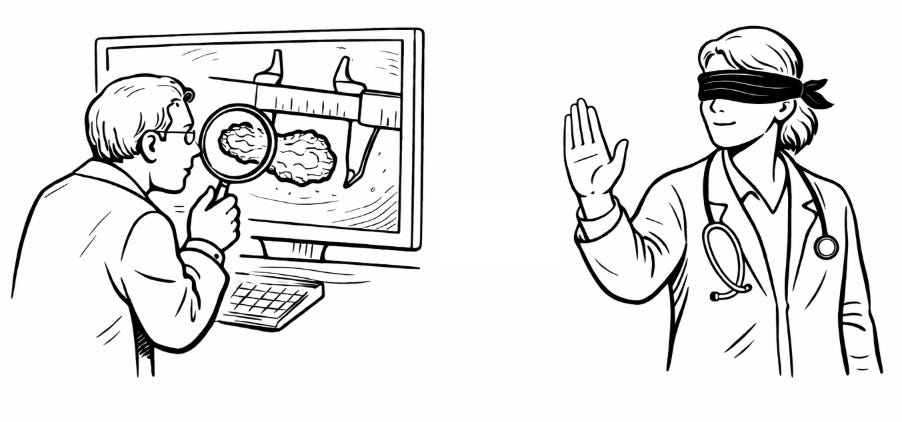
For decades, superficial radiation therapy (SRT) has been an accepted option in the treatment of nonmelanoma skin cancer (NMSC), but…
Acceptance is not the same as advancement, and in medicine, history alone does not justify continued use, especially when something better is available now.
At some point, “standard of care” becomes a reflection of habit, not progress.
So, it’s time to ask a more direct question:
Is traditional SRT still a standard of care, or is it becoming a legacy therapy we’ve been slow to move beyond?
The Core Issue: SRT Treats Without Seeing
At its core, traditional SRT is built on estimation.
Clinicians approximate:
Tumor depth
Lateral margins
Treatment response
There is no direct visualization of the tumor beneath the skin.
Dermatologists are, quite literally, treating what they cannot see.
Even in experienced hands, this introduces unavoidable uncertainty:
Residual tumor may go undetected
Treatment margins may be inaccurate
Clinical “clearance” may not reflect biological reality
This isn’t a critique of SRT’s historical value; it’s a recognition of its limitations.
SRT didn’t fail medicine. Medicine outgrew SRT.
IGSRT Eliminates the Guesswork
Image-guided superficial radiation therapy (IGSRT) changes the equation entirely.
By integrating high-resolution ultrasound imaging, IGSRT allows clinicians to:
Measure tumor depth and margins with precision
Customize treatment based on real data—not assumptions
Track response throughout therapy
Confirm resolution before declaring success
This is not a refinement. This is the difference between estimation and evidence.
And once you can see the tumor…
“Close enough” stops being good enough.
The Data Isn’t Incremental, It’s Disruptive
The outcomes associated with IGSRT are not marginally better; they are meaningfully superior.
2,880 lesions: ~99.23% control (0.7% recurrence)
Traditional SRT: ~1.9% to 6%+ recurrence
3,000+ lesions: ~99.2–99.3% control
20,000+ lesions: up to ~99.6% control in real-world settings
At this level of performance, we are no longer talking about preference.
We are redefining what “good outcomes” actually mean.
Perhaps most disruptive of all…
IGSRT is now approaching Mohs-level outcomes at 2 years, without surgery.
That should change the conversation.
When Does “Better” Become the Baseline?
Medicine doesn’t update standards of care overnight, but it does reach tipping points.
And those tipping points happen when:
Better tools exist
Better outcomes are repeatable
And the gap becomes too large to ignore
IGSRT is rapidly approaching that point, which leads to a harder truth:
If you can see the tumor, measure it, and confirm it’s gone… why would you choose not to?
The Inconvenient Reality: SRT Is Starting to Look Obsolete
In every other area of oncology, image guidance is not optional.
Medical professionals don’t:
Radiate tumors they can’t visualize
Operate without seeing the target
Accept uncertainty when precision is available
Skin cancer is one of the last places where “blind treatment” has been tolerated.
That tolerance is running out, and as it does, SRT begins to look less like an alternative…
and more like a technology that simply hasn’t caught up.
So, why Is SRT Still Being Used?
If the clinical argument is shifting, why hasn’t practice followed?
Because medicine doesn’t change based on data alone.
It changes based on:
Access
Economics
Workflow
And how easy it is to keep doing what we’ve always done
SRT persists not because it’s superior, but because it’s familiar, and familiarity is one of the hardest forces to overcome in healthcare.
The Next Layer Most People Miss
But even that explanation is incomplete, because adopting IGSRT is not just about upgrading technology.
This is where the conversation becomes more nuanced, and more revealing.
Not all IGSRT is the same.
There is a difference between having a device with imaging and delivering a treatment model built around image guidance.
Technology alone doesn’t create outcomes; execution does.
Where This Is Heading (Fair warning to those still offering non-image-guided SRT)
If current trends continue, the question won’t be whether IGSRT is better.
That case is increasingly being made, in data and in practice.
The real question will be…
How long will the field continue to accept “good enough” when something measurably better is available?
And just as importantly:
Who is actually equipped to consistently deliver that higher standard?
Because the future of non-surgical skin cancer treatment won’t just be defined by imaging.
It will be defined by how that imaging is translated into real-world outcomes.
In our next article, I’ll explore that distinction - why the difference between owning a device and delivering a true IGSRT treatment model matters, and why that gap may be larger than most realize.
I’m Adam Lefton, and I’m the Chief Brand Officer for GentleCure by SkinCure Oncology. Together, with our 400-plus practice partners, we’re changing the face of skin cancer treatment in America
Stay ahead of the shift. The standard of care doesn’t change all at once. It changes when enough people start asking better questions. If you’re thinking differently about how nonmelanoma skin cancer should be treated, you’re not alone.
Subscribe to The Skin Cancer Treatment Journal to follow this series, where we’ll break down:
Why not all IGSRT is created equal
What separates a device from a true treatment model
And where SRT still fits, if it does at all